Cancer: Lecture Series
Each lecture is viewable via Flash (standard-definition or
podcast-sized, with closed-captions and chapter links) or RealPlayer
(video only, for slower Internet connections).
Click the Player Help link in the Flash video player for more
information.
 2003
Holiday Lectures
2003
Holiday Lectures
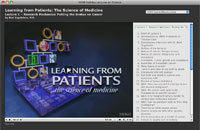
Learning from Patients:
The Science of Medicine
Lecture 1 —Research Mechanics: Putting the Brakes on Cancer, by Bert
Vogelstein, M.D.
Flash or RealPlayer
Lecture 2 —Chaos to Cure: Bringing Basic Research to Patients, by
Bert Vogelstein, M.D.
Flash or RealPlayer
Lectures Three and Four are
presented by Huda Zoghbi, M.D., and can be found under the
"Neuroscience" topic in the menu bar.
Discussion Session: Bioethics
Moderators: Bert Vogelstein, M.D., Johns Hopkins
University; and Huda Y. Zoghbi, M.D., Baylor College of Medicine.
Flash or RealPlayer
For older video formats, visit the Cancer
Lecture Archives page.
"Socks Before Shoes: How Cells Keep Track of Their
Chromosomes"
Dr. Andrew Murray
Professor of Biology, Molecular and Cellular Biology
Director, Center for Genomics Research
Every time a cell divides, it runs the risk of generating
daughters with too few or too many chromosomes. These
mistakes play a crucial role in many cancers. Dr. Murray
will discuss the mechanisms by which cells make sure that
their chromosomes are properly lined up on the cell division
machinery before the cell divides.
"Subcellular Crisis Prevention: How Cells Detect
Damaged Chromosomes"
Dr. Matthew Michael
Assistant Professor of Molecular and Cellular Biology
Dr. Michael will discuss the mechanisms and pathways that
function to maintain stability of the genome. His lecture
will include an overview of research being conducted to
understand DNA damage checkpoint control.
"Targeted Therapy for Cancer"
Dr. Harold Burstein
Assistant Professor of Medicine, Harvard Medical School
Clinician and Researcher, Dana Farber Cancer Institute
New cancer treatments are being evaluated that take
advantage of a better understanding of the biology of cancer
cell growth. Dr. Burstein will focus on "targeted" therapies
for cancer and new drugs that are changing our treatment
strategies. The use of hormonal therapies, growth factor
receptor inhibitors, and angiogenesis inhibitors will be
highlighted.
"Molecular Pathogenesis of Breast Cancer"
Dr. Joan Brugge
Professor of Cell Biology, Harvard Medical School
Dr. Brugge will discuss the pathogenesis of breast cancer
and studies to define the molecular events that control the
initiation and progression of breast cancer. In vitro models
that mimic the behavior of breast epithelial cells in vivo
will be included in the discussion.
"The Host Response to Cancer: Friend or Foe?"
Dr. Glenn Dranoff
Associate Professor of Medicine, Harvard Medical School
Clinician and Researcher, Dana Farber Cancer Institute
The immune system plays dual roles during cancer
development. Host responses may inhibit tumor development
and progression by controlling infection, inflammation, and
immunity. Alternatively, cancer cells may subvert the host
response to promote growth, attenuate death, and facilitate
invasion and metastasis. A more detailed understanding of
host/tumor cell interactions provides new opportunities for
crafting cancer immunotherapy.
MIT World Video Lecture Series - Cancer